English
 French
 German
 Spanish
Black joy at the world cup and me
Black folks competing in a white world. Five stories from Team USA, a couple from me, and a salute to basketball coach Gene Nakamura.
I’m in the early, early stages of writing my first memoir. In it I will explore how we over-romanticize wealth and fame, especially in America, to our young women. I’ve been working with my writing coach, talking through outlining and what to include in this memoir. She suggested an exercise I started, dumping memories. There’s no order, no polish, just getting them out of my head and onto the page. Eventually, from there, I’ll decide what makes this book and what goes into the next, or the next.

This summer, watching HBO’s U.S. Against the World, then the World Cup, triggered my love for sports and an interesting correlation I made with competition.
Every week I faithfully watched as the docuseries followed the men’s national team on their road to the World Cup. I loved how it told the stories of the racially and spiritually diverse team. It showed how competitive the sport is, and how competitive it is to stay on the roster. And my favorite part? Hearing the stories of the young Black men on Team USA. Here are five players whose stories fascinated me and had me PROUD to cheer for our team:
- Tim Weah is the son of George Weah, the only African ever to win the Ballon d’Or, who went on to become President of Liberia. Tim was born in Brooklyn, raised between New York and the world. He truly is soccer royalty and the son of a president.
- Tyler Adams was raised by his mother, Melissa, who understood that her son’s life was in her hands so she poured everything into herself and him. She put herself through college while believing in and fighting for his dream of becoming a soccer star.
- Folarin Balogun was born in New York almost by accident. His Nigerian mother gave birth to him here, then took her baby home to London. He was raised there and came up through England’s youth national teams. He was so good that Team USA came for him.
- Weston McKennie is a military kid. His father served in the U.S. Air Force, and Weston fell in love with soccer as a little boy on a base in Germany. The pride his father shows every time he’s on screen is truly beautiful.
- Alex Freeman is an NFL kid, like my handsome guy Keyshawn Jr. He’s the son of a wide receiver and a soccer star, also like my son! My handsome guy dominated on his team in East Oakland. And like Jr.’s dad, Alex’s father, Antonio Freeman, was a Pro Bowler. Plus, Alex scored for us in this World Cup!

To my surprise and disappointment, we were out in the Round of 16. But because the tournament still gave me so much Black Boy Joy to root for, I kept watching. And Spain won it all! Lamine Yamal and Nico Williams, sons of African immigrants, led and played with a freedom that made me cry with them. It was pure Black joy!
The memoir excerpts: My First Love – Competition
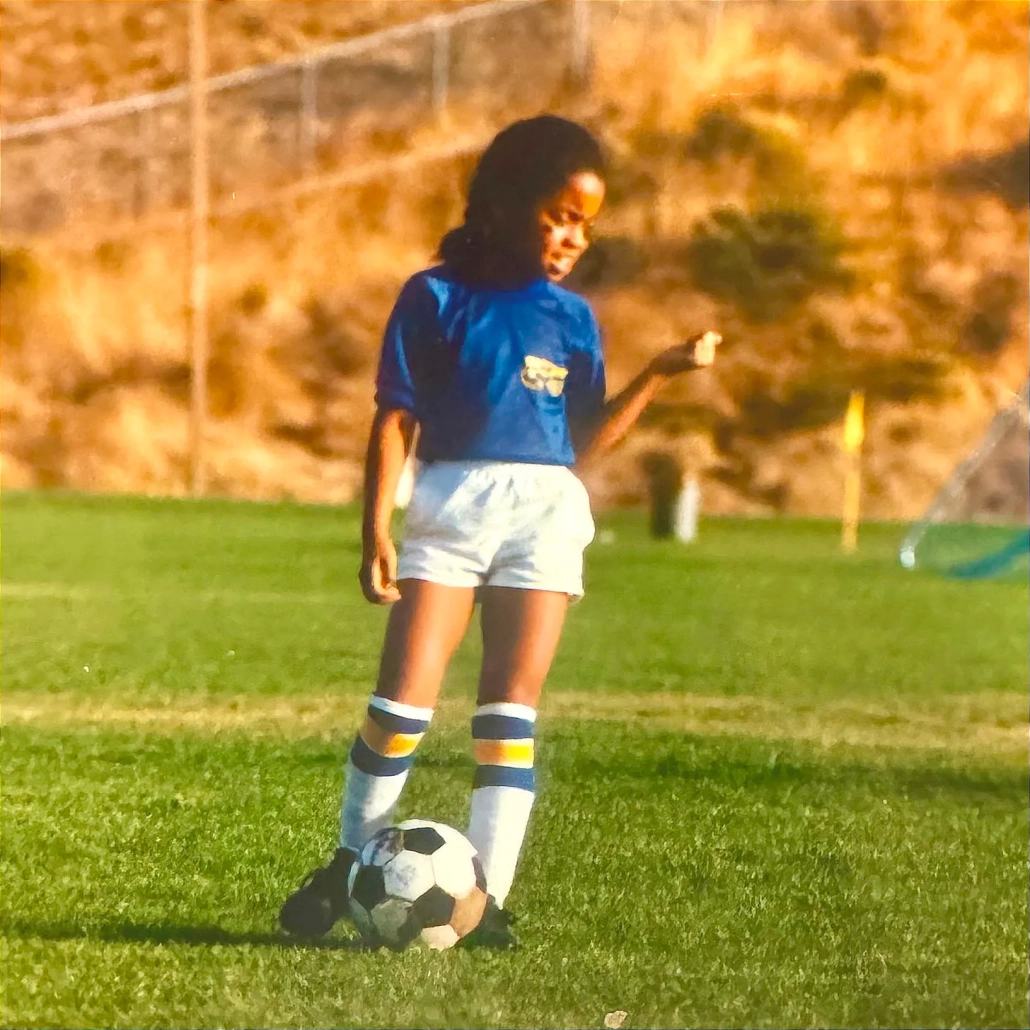
My love of sport came early. Around six or seven, my parents enrolled me in soccer, and from the moment I hit that field, I was in love. First it was co-ed soccer; I think that’s where I learned to be so fearless, to play with grit, to push and elbow, with a win-the-ball-or-foul mentality. But it was when I got grouped with girls my age who looked like me that I had the most fun.
I am fast and tough; I will make contact, and I am aggressive. I excel in both defense and offense, and growing up, I was often placed as center halfback, going up with the forwards when we were on offense, then back with the fullbacks for defense.
Above: press play — That’s me in the yellow, only 12 years ago.

I quickly realized the soccer field was different from the classroom. I wasn’t at the mercy of racist teachers who had their favorites. I decided how I would show up on that field, and it was, and still is, very difficult to beat me.
My favorite games were when we played in cities like Concord or Orinda, against majority-white teams. Outside of the referees:
On the soccer field, white people lose their privilege…
I can elbow, push, kick, and I always dominate out there, even if we, as a team, lose.
After every game, I left that field excited to give the customary end-of-game handshake, where we’d slap hands with each player on the opposing team. “Good game,” I’d always say, with my beautiful smile and my head high.

And when the game was over, so was our fight.
I don’t know yet if this memory makes the book. But I know that the competitor, the one who decided how she showed up and won every time, is who you’re getting going forward.
Before I go, I want to honor someone who was also part of my sports memories, Coach Gene Nakamura. He passed in July at 81. Interestingly, he showed up in these memories, almost preparing me for his passing.

With basketball, I approached the game with that same level of intensity as soccer. I think because of it, basketball footwork came easy to me. Shooting and dribbling did not, so I had to really work on those skills. But in basketball, I was always the best defender. I would steal the ball so quickly, so often, that it became what I was known for.
The coach at Berkeley High, Coach Nakamura, was also the vice principal at Willard. Berkeley High women’s basketball has a long tradition of winning, and we’re talking D1, state-champion level. I played two years on the basketball team at Willard, and the natural progression was to get ready for Berkeley High basketball. At Willard, our head coach was Keiko, a real-life Japanese beauty queen. And that is one of the things I loved about her.


Coach Keiko gave us space to embrace our beauty, and to ball.
That’s always how I’ve seen sports, a place to compete. Not taking away from my beauty, not being masculine, just pure competition.
And with me, in any arena, especially competition, I bring in beauty.
Nak, you built a legacy of hard work, dedication, and teammates who truly became my family. Thank you, may you rest in peace.